End the musical chairs: towards a direct election of the mayor?
How mayors are appointed in Flanders, Wallonia and the Netherlands, and what a directly elected mayor would mean for relations with the municipal council.
Translated from Dutch. The original is the authoritative text. Read the original.
Key points
In Flanders, the mayor is nominated by the new municipal council majority and appointed by the Flemish Government (Art. 59 Municipal Decree); Wallonia uses a semi-automatic appointment, and in the Netherlands the Crown appoints the mayor, although Article 131 of the Dutch Constitution was deconstitutionalised in November 2018. The authors compare Flanders' (inverted) monist municipal government with Dutch dualism since 2002. They conclude that a directly elected mayor would require a dualist system and a cultural shift.
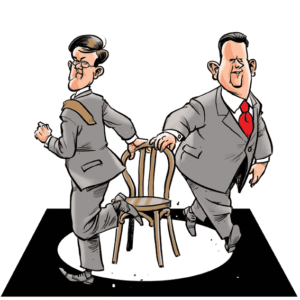 The municipal elections of 14 October 2018 were the starting signal for a local game of musical chairs. Coalitions were forged and mayoral sashes handed out. After all, the elected candidate with the most votes does not necessarily become the next mayor. How much weight does the voter’s vote carry and how far does the power of the parties reach? It is not only in Belgium that people ask why the mayor is not actually directly elected. In the Netherlands, the introduction of an elected mayor is a topical debate today, and in Germany it stirred emotions a few years ago. In the debate on the direct election of the mayor, it is important also to consider the changes this brings about in the relationship with the municipal council.
Interest in a directly elected mayor
The tone was set immediately when mayor Bart Somers, on the VTM midday news of 16 September, called for ‘the direct election’ of the mayor. Although the municipal elections are over, this question remains topical. The game of musical chairs for the mayoral sash has caused quite a stir in several Belgian municipalities. The city of Ghent and its future mayor Mathias De Clercq are a good example of this. He claimed the sash for himself on election night after obtaining the most preference votes. As will become clear below, however, the appointment of the mayor in Belgium does not work that way. It therefore took him many weeks of political wrangling and concessions to form a coalition and secure the sash.
Awarding the Flemish mayoral sash
The current appointment of mayors in Flanders is governed by Article 59 of the Flemish Municipal Decree. The mayor is nominated by the municipal councillors of the new majority and appointed by the Flemish Government. The mayor-designate then takes the oath before the Governor. This arrangement is based on the fact that the mayor, as a local office-holder, is the head of the municipality, but also acts as representative of the Government at municipal level. De facto the appointment is made by the municipal council, because the Flemish Government, without prejudice to its own power of assessment, almost always follows the proposals of the municipal council. Furthermore, the mayor is by law chair of the college of mayor and aldermen and may be nominated as chair of the municipal council.
In 2001 the Flemish Dewael Government endorsed the principle of the direct election of the mayor in a supplementary government statement with the aim of giving citizens a genuinely tangible decision-making power in local elections. Nevertheless, the governing partners did not succeed in adopting the Municipal Decree, including the direct election. The realisation of a new Municipal Decree became one of the major challenges of the 2005-2009 legislative term. Owing to the great time pressure, however, it was decided to discuss the more delicate themes, including the direct election of the mayor, later at a forum on strengthening democracy. To this day, neither a forum nor a change in the appointment of mayors has taken place.
The semi-automatic appointment in Wallonia
How does the Flemish system compare with that in Wallonia? In the south of the country, the Code Wallon de la démocratie locale et de la décentralisation opted for a
semi-automatic appointment of the mayor. The appointment takes place in three phases: first the formation of the coalition, then the determination of the largest party within that coalition, and finally the candidate with the most preference votes from that party is appointed mayor by operation of law. Although at first sight this seems a form of more direct democracy, its significance should not be overestimated. The influence of the citizen is in fact still indirect. The appointment is after all influenced by the formation of the majority coalition, which does not necessarily include the largest party. In Flanders in 2013, the largest party was part of the administration in 78% of the municipalities. In Wallonia this share was only 67%.
The debate in the Netherlands
In the Netherlands, too, the mayor is for the time being appointed by the higher authority. Under Article 131 of the Dutch Constitution, the mayor is appointed by the Crown. The municipal council, in consultation with the King’s Commissioner, draws up a vacancy profile. After the Commissioner has made a selection and the confidential committee, composed of municipal councillors, has given its advice, the municipal council nominates two candidates. On that basis, the Minister of the Interior appoints the mayor. As in Belgium, the minister follows the nomination of the municipal council in most cases. Nevertheless, there are certainly some differences between the two countries.
First, the influence of the hierarchically higher authority is greater owing to the input of the Commissioner. Second, the terms of office of the municipal council and the mayor do not coincide, since the former is elected for four years while the latter is appointed for six years. Finally, one must also take into account the different political cultures. The Dutch mayor is primarily a rather apolitical administrator, whereas the Flemish mayor has a clearly political mandate.
On 20 November 2018, moreover, the proposal to deconstitutionalise Article 131 of the Dutch Constitution was approved. This ends a first phase in the years-long political debate on the method of appointing the mayor. The approved proposal, however, does not contain a method of appointment. Deconstitutionalisation does make it easier for the legislature to bring about a change in the future. Whereas before 20 November a constitutional two-thirds majority was required to approve a proposal introducing the elected mayor, today only a statutory amendment by simple majority would be needed.
Municipal relations
Given the close historical ties between Belgium and the Netherlands, it is not surprising that the electoral systems described above largely resemble each other. The same can be said of the municipal governing bodies. Both Flanders and the Netherlands have a municipal council and an executive body, respectively the college of mayor and aldermen (CBS) and the college of mayor and aldermen (CBW). Yet here too there are some fundamental legal and politico-cultural differences.
Since 2002 the Netherlands has had ‘local dualism’. Under it, the different political bodies, the municipal council and the CBW, have their own powers and legitimacy. In other words, political leadership does not rest with a single body. In this form of government, the CBW is free both de facto and de iure to determine its own policy. The main aim of the legislature, however, was to emancipate the municipal council vis-à-vis the CBW. The result was that aldermen had to give up their seats in the municipal council and the mayor lost his right to vote. Changing practice, however, proved not so simple. Dualisation has often been labelled ‘duellisation’. It resulted in increased politicisation and in a rise in the forced departure of mayors and aldermen. Some even consider that the implementation of dualism has simply failed.
A similar tendency to emancipate the municipal council vis-à-vis the CBS is also visible in Flanders, albeit on a smaller scale. Examples are the structural ungovernability of the municipality, the convening of the municipal council at the request of one fifth of its members, and the fact that the mayor is no longer chair of the municipal council by law. In theory, however, Flanders is characterised by a monist system in which the municipal council is in charge. Functionally, this means that one body, in theory the municipal council, forms the centre of gravity of municipal powers and decision-making. In terms of personnel, it means that the mayor and the aldermen also sit in the municipal council and have voting rights there. Given the far-reaching professionalisation, party politicisation and party discipline, Flanders is nevertheless de facto characterised by an inverted monism. It is not the municipal council but the CBS that takes the lead within a relatively stable but inverted monism.
Quo vadis directly elected mayor?
In sum, the current method of appointing the mayor, in both Flanders and Wallonia, is in se indirect. The mayor derives his democratic legitimacy from the municipal council and thus indirectly from the voter. A directly elected mayor would have direct legitimacy. To avoid a situation in which the mayor has too much power, a dualist system seems appropriate in this case.
Taking inspiration from the Netherlands would mean decoupling the municipal council and the CBS. Aldermen would no longer be part of the municipal council and their method of appointment could also be called into question. The following questions, among others, would then have to be asked. Are the aldermen nominated by the municipal council or appointed by the mayor? How do relations and working methods change when the mayor is of a different political colour than the municipal council? Is cohabitation allowed? Moreover, one must bear in mind that an elected mayor will inevitably have an agenda of his own. It goes without saying that this may encourage ‘duellisation’, a fortiori since the Flemish mayor is already considerably more politicised than his Dutch counterpart.
As the situation in the Netherlands shows, the transition from a monist to a dualist system requires not only a legal adjustment but also a genuine cultural shift. In this blog post it is impossible to deal fully with the desirability of a directly elected mayor, because the context, as well as the administrative and political environment, are of crucial importance in this story. In any event, it is necessary to reflect sufficiently on the consequences for the relationship between the municipal council and the college of mayor and aldermen.
BIBLIOGRAPHY
News
Somers: “Burgemeesters zouden rechtstreeks verkozen moeten worden”, 16 september 2018, https://www.knack.be/nieuws/belgie/somers-burgemeesters-zouden-rechtstreeks-verkozen-moeten-worden/video-iwatch-1197913.html (consultatie 4 november 2018).
DE VADDER, I., “Kwart van jonge ‘nieuwe stemmers’ verkiest autoritaire leider boven democratie”, 1 oktober 2018, https://www.vrt.be/vrtnws/nl/2018/10/01/first-voters/ (consultatie 4 november 2018).
Legislation
Bijz.Wet. 13 juli 2001 houdende overdracht van diverse bevoegdheden aan de gewesten en de gemeenschappen, BS 3 augustus 2001.
Wet 13 juli 2001 houdende diverse institutionele hervormingen betreffende de lokale instellingen van het Brussels Hoofdstedelijk Gewest, BS 3 augustus 2001.
Scholarship
Journals
DE VRIES, J., “Wat doen we met de burgemeester?” Gst. 2003, 59-66.
ELZINGA, J., “Gekozen burgemeester heeft een zeer zwak fundamenet”, Gst. 2004, 88-94.
ELZINGA, J., “De door de bevolking gekozen burgemeester is strijdig met het politieke primaat van de gemeenteraad”, Gst. 2004, 181-185.
HENNAU, S., KEUNEN, S. en ACKAERT, J., “Een (meer) rechtstreekse burgemeestersverkiezing in Vlaanderen? De invloed van kieswetgeving op het Vlaamse burgemeestersbestand”, TBP 2017, 494-510.
PILET, J-B., DELWET P. en VAN HAUTE E., “Eerste lessen uit de automatische benoeming van burgemeesters in Wallonië”, Res Publica 2007, 34-45.
Books
ASTAES, J., et al., Burgemeester: Statuut, Brugge, Die Keure, 2012, 324 p.
BREDERVELD, E., Gemeenterecht. Deventer, Kluwer, 2005, 302 p.
DEVOS, C. et al., Een Plattegrond Van De Macht, Gent, Academia Press, 2016, 663 p.
VANDE LANOTTE, J., GOEDERTIER, G. en HAECK, Y., Belgisch Publiekrecht, Brugge, Die Keure, 2015; 1594 p.
Edited volumes
ACKAERT, J., “Transformation of the Political Executive in Belgian Local Government” in BERG, R. en RAO, N. (eds.), Transforming Local Political Leadership, London, Palgrave MacMillan, 2005, p.169.
ACKAERT, J., DE WINTER L. en HENNAU S., “Met man en macht. Over mensen, macht en beleid bij lokale coalitievorming” in DESCHOUWER K., VERTHE T. en RIHOUX B. (eds.), Op zoek naar de kiezers. Lokale partijafdelingen en de gemeenteraadsverkiezingen van oktober 2012, Brussel, Academic & Scientific Publishers nv, 301 p.
HEINELT, H. en HLEPAS, N-K., “Typologies of Local Government Systems” in BACK, H., HEINELT H. en MAGNIER A. (eds.), The European Mayor. Political Leaders in the Changing Context of Local Democracy, Wiesbaden, VS Verlag für Sozialwissenschaften, 2006, p. 356.
STEEN, T., “Dualistische en monistische gemeenten. Bestuurlijke hervormingen in Nederland en Vlaanderen”, in REYNAERT H. en DE RYNCK F. (eds.) De Gentse Lezingen, Brugge, Vanden Broele, p 37.
STEEN, T. en WILLE, A., “Strengthening Local Government in the Netherlands and Flanders: Similar Problems, Different Solutions?” in REYNAERT, H., STEYVERS, K., DELWIT, P. en PILET, J.-B. (eds.), Revolution of Renovation? Reforming Local Politics in Europe, Brugge, Vanden Broele, 2005, 643 p.
WOLLMANN, H., “The directly-elected mayor in German local government” in BERG, R. en RAO, N. (eds), Transforming Political Leadership in Local Government, Hampshire/New York, Palgrave Macmillan, 2005, 29-41.
Reports
VAN DER KOLK, H. en VETTER, A., Als burgemeester in Duitsland ervaring uit verschillende deelstaten, onuitg. rapport Faculteit Bestuur, Beleid en Technologie Universiteit Twente en Departement of Sociology and Political Science University of Stuttgart 2004, https://kennisopenbaarbestuur.nl/media/62897/gekozen-burgemeester-ervaringen-met-de-gekozen-burgemeester-in-duitsland.pdf
VAN DER LELIJ B., KEUCHENIUS C. en DE GRAAF M., Het ambt van burgemeester onderzoek naar de publieke opinie over de rol en positie van burgemeester, rapport Ministerie van Binnelandse Zaken en Koninkrijkrelaties, 2016, https://kennisopenbaarbestuur.nl/media/254516/het-ambt-van-burgemeester.pdf
Cartoon
DE REIJGER, H., Rutte vs. Roemer, verschenen in NRC Handelsblad, Augustus 2012.