The bill on home entries: what now?
The 2018 Belgian bill allowing home entries to detain irregular migrants, tested against Article 8 ECHR, the Return Directive and the Dutch Aliens Act.
Translated from Dutch. The original is the authoritative text. Read the original.
Key points
The post analyses the Belgian bill amending the Aliens Act to allow officials, with the investigating judge's authorisation, to enter the residence of an illegally staying foreign national, including a third party's home, to detain and remove that person. The authors accept that the measure might be justified under Article 8 ECHR and the Return Directive, but criticise the reduced role of the investigating judge and the lack of full judicial review. They compare it with the Dutch Aliens Act, which has allowed home entries since 2000 but provides for objection or appeal against the authorisation.
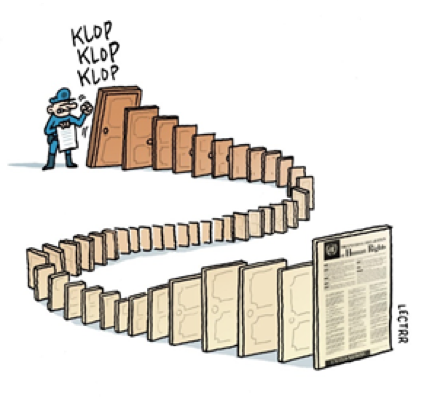
Belgian asylum and migration policy has recently been a hot topic. After the Sudan issue, the controversial bill amending the Aliens Act concerning home entries is once again back on the drawing board. The bill is a government initiative to guarantee an efficient and effective return policy towards foreign nationals who are illegally present in Belgium. It makes it possible to enter the place of residence of the illegally staying foreign national – which may also be the home of a third party – without consent, with the aim of administratively detaining that person and ultimately removing them from our country. The investigating judge would, however, have to authorise the home entry. This blog post discusses the underlying motives of this bill and tests the bill against an equivalent in the Netherlands.
Bill on home entries in Belgium
The bill amending the Aliens Act introduces the term ‘home entry’ into the Belgian legal system for the first time. The term differs from the notion of ‘house search’ in that a home entry takes place within an administrative procedure and not within a judicial investigation.
The Belgian bill amending the Aliens Act seeks to address two problems. First, it highlights the problem of the illegally staying foreign national who does not comply with a removal measure. When an illegally staying foreign national does not comply with an enforcement measure to leave Belgian territory, the Immigration Office will proceed to forced removal. To that end, the illegally staying foreign national must be administratively detained. Often, however, that person is not in a public space, making detention impossible. The bill creates a legal framework for the competent officials to enter the place of residence of the illegally staying foreign national without that person’s consent, between 5 a.m. and 9 p.m. In this context, it is not inconceivable that the illegally staying foreign national is in the home or residence of someone who is lawfully resident in Belgium, for example if family or friends offer the person in question shelter (whether or not temporarily). In that case, too, a home entry would be possible, in which the police can proceed to administrative detention. In order to identify the foreign national more quickly, there is even the possibility of actively searching for identity documents and taking them along. The second problem concerns address checks. Checks are carried out by the police services to verify whether the illegally staying foreign national is complying with an imposed removal measure. A study in 2016, at the request of the Immigration Office, showed that almost 70% of address checks were negative and that almost 40% of these were classified as ‘no longer resides at address’ and 7% as ‘does not cooperate’. Often the person concerned is in fact present, but refuses to cooperate or to open the door to a police officer.
This bill did not come about without a struggle, however. From various quarters, criticism has been voiced against the bill. Politicians, NGOs and lawyers alike do not fully support the proposed arrangement. The criticism mainly refers to the inviolability of the home and the right to respect for private life of the illegally staying foreign national and of the third party sheltering him. Those principles are protected by Article 8 of the European Convention on Human Rights as well as Articles 15 and 22, first paragraph of the Belgian Constitution. They are not absolute rights, however, since the aforementioned articles allow derogations from them – under certain conditions. In Belgium, home entry can be justified in the light of the objectives of the Return Directive, read in conjunction with the exception grounds of Article 8 ECHR. Public order is put forward as the legitimate aim. After all, it falls within the control of the entry and residence of non-nationals. The government could also argue that it is a necessary measure to be able to enforce the removal measure concerned and thereby pursue an efficient return policy (art. 8, 1. Return Directive) in which illegal immigration is combated (European Pact on Immigration and Asylum).
Although a justification for the proposed home entry arrangement could thus be invoked, it does not appear entirely self-evident. Because there is no full judicial review – as there is in the case of a house search – the home entry does not yet appear to be fully justified. This is also apparent from the opposition of the investigating judges to the current arrangement. In the current bill, the authorisation of the investigating judge is required to enter a home in order to safeguard fundamental rights and freedoms. As the bill now stands, the role of the investigating judges appears to be limited to merely applying a stamp. Unlike in the context of a judicial investigation, the investigating judge only has to give ‘administrative permission’ for the home entry, so that the investigating judge can and must no longer examine its lawfulness. The authorisation for home entry is therefore no more than a mere ‘formal check’, giving the investigating judges less control over the situation compared to a judicial investigation. In order to avoid arbitrariness and ensure uniformity, it seems advisable to revise this part of the bill, so that the investigating judges can actually safeguard the rights and freedoms of the persons concerned. The investigating judges should, for example, at least be able to weigh the proportionality of the measure against the facts, which is only possible if they handle the entire file.
Prime Minister Michel has decided to take the bill into his own hands. He promises to listen to the objections, but a breakthrough is not yet in sight. The political parties agree on the aim of the law, but still have to reach a compromise on the content of the text. From the liberal side, voices are even reportedly being raised to negotiate on home entries at third parties who shelter illegally staying foreign nationals. They would reportedly want to remove home entries at third parties from the bill, thereby addressing a thorny issue. Because it was not yet on the agenda of the most recent Council of Ministers, it will presumably have to wait until a following Council of Ministers, after which the matter will probably dominate the media again. Earlier, the Brussels Parliament also voiced fierce criticism by means of a motion for a resolution to reject the bill.
Home entries possible in the Netherlands
When we compare the Netherlands with Belgium, we find that the Netherlands has already included an arrangement for home entries in its Aliens Act since 2000. A rejection of an application for a residence permit leads to a return decision. If the foreign national disregards the obligations arising from it, the officials responsible for supervising illegally staying foreign nationals may enter any place, including the place of residence, without the consent of the occupant or of a third party (Art. 27, 1, c Vreemdelingenwet). Contrary to what the Belgian bill provides, the illegally staying foreign national in the Netherlands can lodge an objection or appeal against this decision. In Belgium, an appeal can only be lodged against the decision of the investigating judge on grounds of irregularities in the authorisation. The foreign national cannot lodge a separate appeal against the authorisation for home entry itself. On that point, the Belgian bill can learn from the Dutch Aliens Act.
As regards the grounds on which a home entry is based, however, there is not much difference with the Belgian bill. The Dutch Article 53 provides that the competent official has the power to enter the home without the occupant’s consent “if, on the basis of facts and circumstances, measured by objective standards, there is a reasonable suspicion that a foreign national without lawful residence is staying at that place”. Article 5 of the Belgian bill contains the same grounds. The Flemish Bar Association (Orde van Vlaamse Balies) nevertheless encouraged the notion of ‘serious grounds’ instead of ‘reasonable grounds’. Nonetheless, the application of ‘a reasonable suspicion’ has also stood for years in the Netherlands.
Conclusion
The Belgian government bill amending the Aliens Act concerning home entries seeks to address a number of existing problems relating to the removal of illegally staying foreign nationals. Above all, it seeks to achieve an efficient and effective return policy for foreign nationals who are illegally present in Belgium. It creates the possibility, regardless of where the foreign national is staying, to enter the home without consent, although voices are being raised among the rank and file of certain political parties to amend the bill on that point. The investigating judge must authorise the home entry.
Although the criticism is that the above jeopardises the constitutionally guaranteed inviolability of the home and respect for private life – of both the illegally staying foreign national and the person sheltering him – it may possibly be regarded as a justified derogation from these principles. The government can base the reasoning behind home entry on the European Return Directive, which requires the member states to take all necessary measures to remove an illegally staying foreign national. That does not alter the fact that the current bill shows some gaps. Reflection is needed on the role of the investigating judges and the legal protection of illegally staying foreign nationals. After all, there is no full judicial review, as there is in the case of a house search. In that respect, Belgium can also learn from our northern neighbours. The Netherlands has had an arrangement on home entries for 18 years to detain illegally staying foreign nationals and remove them from the country. In the Netherlands, however, an objection or appeal is possible against the authorisation for home entry, which is an important element of the proportionality test weighing the severity of the measure against the facts. This offers additional safeguards for the illegally staying foreign national, which are absent in Belgium. In any event, the current bill has fuelled the debate on home entry in Belgium. Whether and when white smoke will appear remains to be seen.
Bibliography
BAILLEUX A. en GERARD P., “Standpunt Orde van Vlaamse Balies wetsontwerp 2798 van 7 december 2017 tot wijziging van de wet van 15 december 1980 betreffende de toegang tot het grondgebied, het verblijf, de vestiging en de verwijdering van vreemdelingen teneinde de uitvoering van de maatregelen tot verwijdering te garanderen (woonstbetreding)”, Orde van Vlaamse Balies 2018, www.ordeexpress.be/UserFiles/ArtikelDocumenten/
Nota%20wetsontwerp%202798%20woonstbetreding%20NL.pdf.
BERVOET D., “Michel koopt tijd over omstreden wet huiszoekingen illegalen”, De Tijd 2018, www.tijd.be/politiek-economie/belgie-federaal/Michel-koopt-tijd-over-omstreden-wet-huiszoekingen-illegalen/9978121 (geraadpleegd op 16 maart 2018).
BOUHON F., BREMS, E. et al., “Woonstbetredingen en de fabel van de kikker”, De Standaard 2018,
www.standaard.be/cnt/dmf20180129_03328767(geraadpleegd op 6 maart 2018).
CONINGS C., Klassiek en digitaal speuren naar strafrechtelijk bewijs, Mortsel, Intersentia, 2017, 862 p.
DERUYCK F., Overzicht van het Belgisch strafprocesrecht, Brugge, Die Keure, 2017, 315 p.
JUSTAERT M., “Regering zoekt uitweg voor wet op woonstbetredingen”, De Standaard 2018, http://www.standaard.be/cnt/dmf20180327_03434049(geraadpleegd op 8 april 2018).
DELAFORTRIE S. en SPRINGAEL C., “Agenda van de ministerraad van 30 maart 2018”, Presscenter.org 2018, http://www.presscenter.org/nl/pressrelease/20180329/agenda-van-de-ministerraad-van-30-maart-2018(geraadpleegd op 9 april 2018).
MOENS B., “Protest tegen huiszoeking bij wie illegalen thuis opvangt”, De Tijd 2018, www.tijd.be/politiek-economie/belgie-federaal/Protest-tegen-huiszoeking-bij-wie-illegalen-thuis-opvangt/9974839(geraadpleegd op 6 maart 2018).
STRUYS B., “Onderzoeksrechters geven negatief advies voor wet op huiszoeking”, De Morgen 2018, www.demorgen.be/binnenland/onderzoeksrechters-geven-negatief-advies-voor-wet-op-huiszoeking-b7d902da/(geraadpleegd op 12 maart 2018).
VAN DER AUWERA K., “Huiszoekingsbevel om sans-papiers op te pakken: onderzoeksrechters zijn tegen”, Knack 2018, www.knack.be/nieuws/belgie/huiszoekingsbevel-om-sans-papiers-op-te-pakken-onderzoeksrechters-zijn-tegen/article-normal-954475.html(geraadpleegd op 2 maart 2018).
Wet van 23 november 2000 tot algehele herziening van de Vreemdelingenwet, wetten.overheid.nl/BWBR0011823/2017-12-16.
Wetsontwerp tot wijziging van de wet van 15 december 1980 betreffende de toegang tot het grondgebied, het verblijf, de vestiging en de verwijdering van vreemdelingen teneinde de uitvoering van de maatregelen tot verwijdering te garanderen, Parl.St., Kamer 2017, nr. 54-2798/001.
Voorstel van resolutie om zich te verzetten tegen en ertoe aan te sporen om het wetsontwerp van de federale regering tot machtiging van huiszoekingen te verwerpen, Parl.St., Brussels Hoofdstedelijk Parlement, nr. A-640/1-17/18.
Richtlijn 16 december 2008 over gemeenschappelijke normen en procedures in de lidstaten voor de terugkeer van onderdanen van derde landen die illegaal op hun grondgebied verblijven,
eur-lex.europa.eu/LexUriServ/LexUriServ.do?uri=OJ:L:2008:348:0098:0107:NL:PDF.
Image: source