Noise standards: end of a turbulent community flight in sight?
Brussels aircraft noise standards, the division of powers, two Flemish conflicts of interest, and whether refederalising noise rules would end the dispute.
Translated from Dutch. The original is the authoritative text. Read the original.
Key points
The Regions are exclusively competent for noise nuisance (Art. 6, §1, II Special Act on Institutional Reform), while the federal authority remains competent for Brussels Airport and flight routes; Brussels' zero tolerance from 2017 triggered two Flemish conflicts of interest, the second filed on behalf of the Flemish Community. The Consultation Committee reached no consensus and Brussels applied the stricter standards from 22 April 2017, with fines collected only later. The authors weigh the pros and cons of refederalisation and find it politically unfeasible in the short term but possibly stabilising in the long term.
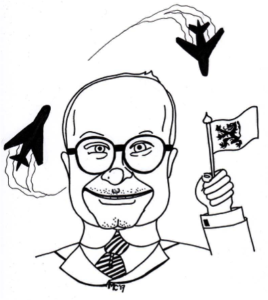 Belgian politics has long been struggling with the issue of flights over Brussels. The trigger for the recent discussions was the decision of the Brussels Government to introduce, as of 1 January 2017, zero tolerance for aircraft exceeding the Brussels noise standards. On the Flemish side, two successive conflicts of interest were invoked against this, out of fear that the application of the stricter noise standards would have considerable negative consequences.
Several working groups are meanwhile trying to reach a solution supported by all parties. However, when the second conflict of interest expired on 21 April 2017, no consensus had yet been reached. The Brussels Government consequently decided to apply the stricter noise standards for aircraft at Brussels Airport as of 22 April 2017. The collection of the fines themselves will only take place within one and a half to two years, which leaves room for negotiation.
The noise standards issue is a complicated question. An explanation of the division of powers and a discussion of the conflict-of-interest procedure will therefore bring more clarity below. In addition, refederalisation will be examined as a possible solution. Is this a deus ex machina that can bring an end to this turbulent community flight, or does refederalisation bring new problems with it?
Division of powers: which pilot can still find their way?
The starting point is the principle of the exclusive material and territorial division of powers, which was confirmed by the Constitutional Court in a judgment of 25 February 1986, under which only one authority is competent to regulate a given matter on a given territory. In this respect, the Communities and Regions are currently – as long as Article 35 of the Constitution has not entered into force – competent only for the powers attributed to them. All other, non-attributed (residual) powers belong to the federal authority.
Noise standards originally formed part of the federal authority’s remit. This power was then transferred to the Regions in the second state reform (1980) and finally enshrined in Article 6, §1, II of the Special Act on Institutional Reform (hereinafter: SAIR). The Regions are thus competent for “the protection of the environment, including that of the soil, the subsoil, water and air against pollution and degradation, as well as the combating of noise nuisance”.
Article 6, §1, X, 7° SAIR also grants the Regions the power over “the equipment and operation of airports and public airfields, with the exception of Brussels-National Airport.” Brussels Airport – which is located on Flemish territory – thus remains reserved to the federal authority, which is moreover also competent for determining the flight routes and runway use of all airports.
When exercising the powers attributed to it, an authority must nevertheless take into account the principle of proportionality. This principle means that an authority must exercise the powers entrusted to it in a manner that does not make it more difficult or impossible for another authority to exercise its powers. The Brussels-Capital Region must take this principle into account when imposing noise standards. It may not go so far as to make it impossible, or at any rate more difficult, for the federal authority to exercise its power regarding the operation and equipment of Brussels-National Airport.
The problem that currently arises does not lie in an excess of powers resulting in a conflict of competence. The current problem lies mainly in the way in which powers are exercised, which may give rise to the filing of a conflict of interest. As mentioned, the Regions are exclusively competent for noise standards on the basis of Art. 6 SAIR. The Flemish, Walloon and Brussels-Capital Regions can each autonomously impose noise standards. Different noise standards may therefore apply in the area around the national airport. The reasonable exercise of powers is therefore essential. In addition, there is also the federal power regarding flight routes. The stricter noise standards over Brussels, combined with the fines, may in the long term lead to greater use of the Leuven route. All of this threatens to have disproportionate consequences for the inhabitants of the Flemish periphery (Vlaamse Rand). They cannot democratically express themselves on the decisions of Brussels politicians, yet they bear the consequences. Member of the Chamber Tim Vandenput considers this a case of “No burden without representation”, after the American “No taxation without representation”. The Flemish Government therefore proceeded to file two conflicts of interest.
Conflict of interest: a black box full of surprises
In this case, the Flemish Government filed two conflicts of interest. A conflict of interest arises when a given entity considers that its interests are harmed by a decision of another component of the state. The origin of a conflict of interest therefore lies not in the legality of a decision taken but in the manner in which the power is exercised. As soon as a conflict of interest is invoked, the decision concerned or its implementation is suspended for 60 days. Within this period the Consultation Committee tries to reach a solution by consensus.
There are two types of conflicts of interest: on the one hand those invoked by a parliament and on the other hand those invoked by a government. There are two major differences between them. First, conflicts of interest at parliamentary level can be invoked by parliaments against bills or proposals of acts, decrees or ordinances and amendments thereto. Once the proposal or bill has been voted or published in the Belgian Official Gazette, a conflict of interest is no longer possible. A conflict of interest at government level is invoked by a government against a decision or draft decision. Unlike the above, the law sets no time limit within which action must be taken. Invoking a conflict of interest after the decision has been adopted and published therefore remains possible. A second major difference lies in the suspension periods. A conflict of interest at parliamentary level leads to a suspension of 120 days, whereas the suspension period for a conflict of interest at government level is only 60 days. Given the issue at hand, the conflict of interest between governments is examined further.
The first conflict of interest was filed by the Flemish Government on 2 December 2016 and expired at the end of February 2017. The Flemish Government then decided on 21 February 2017 to file a second conflict of interest, based on the following grounds. First, the Flemish Government considers that its economic interests are seriously harmed by the Brussels Government’s zero tolerance regarding noise standards for aircraft. According to the Flemish side, ending the policy of tolerance that Brussels had pursued since the introduction of the noise standards in 1999 may affect the employment that Brussels Airport provides. The risk of job losses is real, as airlines could seek refuge at other airports where such fines do not apply. This economic motive is set against the health motives of the inhabitants of Brussels, namely the protection of their environment and health, whereby they demand that fewer aircraft fly over their territory. Second, the Flemish Government argued that there is a serious restriction of the policy freedom and autonomy of the Flemish Community. Finally, a violation of the principle of federal loyalty and of the principle of reasonableness was raised.
Brussels first of all labelled the second conflict of interest inadmissible, since Article 32, §2, second paragraph of the Ordinary Act on Institutional Reform provides that the conflict-of-interest procedure can be initiated only once in respect of the same decision. The Flemish Government refuted this position by arguing that the first conflict of interest was filed on behalf of the Flemish Region, whereas the second was filed on behalf of the Flemish Community. Although under the SAIR the Flemish Government acts in Flanders as both a Community and a Regional body, the Flemish Region and the Flemish Community remain two distinct legal persons which can therefore each separately file a conflict of interest on the same subject. Professors Emmanuel Vandenbossche and Hendrik Vuye, among others, confirm this interpretation. Despite the Brussels opposition, Prime Minister Michel therefore declared the second conflict of interest valid. Vuye even points to the possibility of invoking a third and fourth conflict of interest, this time based on the original 1999 decision of the Brussels-Capital Government to introduce the stricter noise standards.
Refederalisation as an emergency exit?
Could a refederalisation of noise standards be a possible avenue towards a lasting solution? There are advantages and disadvantages to this option.
Supporters of refederalisation mainly put forward the following arguments. First, the federal level of government is the only entity that must take into account the interests and citizens of the entire country. Various interests are at stake in the airport case, such as the economy, public health and the safety of local residents. In that respect, the federal level seems best placed to weigh the various conflicting interests against one another and reconcile them. The criticism that the inhabitants of the Flemish periphery would be excessively affected by the strict Brussels noise standards, even though they cannot influence the decision of the Brussels-Capital Region (cf. “no burden without representation”), could – to a certain extent – be remedied through refederalisation. Second, in other federal countries such as Germany, Austria and Switzerland, noise standards fall within the competence of the federal authority. A comparative study from 2006 showed that, unlike in Belgium, no significant conflicts had arisen in these countries up to that point.
On the other hand, there is also another side to the coin. First, refederalisation will probably not lead to a faster solution in the short term either. Refederalisation could set a future compromise in stone in the long term and thus offer a lasting solution, but a solution acceptable to all those involved must first be reached. At federal level too, however, community tensions clearly remain present. The question can therefore be asked whether refederalisation would not merely shift the problem. At federal level, conflicting interests are also at play that can give rise to conflicts of interest. Moreover, the current handling of conflicts of interest, which already takes place at federal level, namely within the Consultation Committee, clearly offers no guarantee of success. Finally, the current community standstill currently makes it politically impossible to carry out a refederalisation in the short term. In its coalition agreement, the government expressed the wish to ensure institutional calm during its term of office, which runs until the elections in 2019. Moreover, the federal government does not have a special majority in parliament to amend the relevant provisions of the SAIR.
Safe end of the flight or a crash?
We can conclude that a refederalisation of noise standards has advantages and disadvantages. It is, however, highly doubtful whether refederalisation would put an end to the as yet turbulent community flight in the short term. What is certain, however, is that a lasting solution is needed. In the long term, refederalisation, and thus a less fragmented division of powers, could possibly contribute to the necessary stability and clarity. Hopefully the current political pilots will quickly bring this turbulent flight to a safe end and thus avoid a crash.
Bibliography
Art 143 van de Gecoördineerde Grondwet van 17 februari 1994.
Bijzondere Wet tot Hervorming der Instellingen 8 augustus 1980.
Gewone Wet tot Hervorming der Instellingen 9 augustus 1980.
Wet 16 juni 1989 houdende diverse institutionele hervormingen.
Ordonnantie van de Brusselse Hoofdstedelijke Raad van 25 maart 1999 betreffende de opsporing, de vaststelling, de vervolging en de bestraffing van misdrijven inzake leefmilieu.
Beslissing van 19 mei 2016 van de Minister van het Leefmilieu van het Brusselse Hoofdstedelijke Gewest.
Verklaring tot herziening van de Grondwet, BS 28 april 2014, 35.184.
Arbitragehof, 25 februari 1986, B.S., 19 april 1986, 3627.
ALEN, A. en MUYLLE, K., Handboek van het Belgisch Staatsrecht, Mechelen, Kluwer, 2011, 562 p.
GELDERS, D., FACON, P.,”Het nachtvluchtendossier: een complexe materie voor beleid en communicatie”, Burger bestuur & beleid, Vanden Broele, jaargang 1, nr. 4.
KEYAERTS, D., “De geluidsnormen in federaal België Summun ius, summa iniauria”, jura falconis, jg 43, 2006-2007, nr 2, Leuven, p. 177-210.
VANDE LANOTTE, J., GOEDERTIER, G., HAECK, Y., GOOSSENS, J. en DEPELSMAEKER, T., Belgisch Publiekrecht, Brugge, die Keure, 2015, 1594 p.
ARNOUDT, R., “Hoe belangrijk is een vliegwet en waarom is die nodig?”, De Redactie, 21 februari 2017, http://deredactie.be/cm/vrtnieuws/politiek/1.2897935.
BELGA, “Brusselse rechter verwerpt eis tot schrapping vliegroute Leuven Rechtdoor”, De Redactie, 15 april 2016, http://deredactie.be/cm/vrtnieuws/binnenland/1.2629883.
BERVOET, D. en VANACKER L., “Uitgelegd: De Brusselse geluidsnormen”, De Tijd, https://multimedia.tijd.be/uitgelegd/zaventem/.
BOGHAERT, W., “De (procedure)fouten in het geluidsdossier Zaventem”, Sceptr, 9 februari 2017, http://sceptr.net/2017/02/procedurefouten-verstrenging-geluidsnormen-brussel/.
DE VLAAMSE REGERING, “Nota aan het overlegcomité”, 21 februari 2017, DOC. 0160/2, https://www.vlaanderen.be/nl/nbwa-news-message-document/document/09013557801c5d6c.
HET VLAAMS PARLEMENT, “Geluidsnormen en vliegroutes”, https://www.vlaamsparlement.be/dossiers/geluidsnormen-en-vliegroutes.
HET VLAAMS PARLEMENT, “Geluidshinder luchthaven Zaventem – Werkgroepen”, http://docs.vlaamsparlement.be/pfile?id=1253904.
MICHIELSEN, S., “Botsende belangen”, De Tijd, 22 februari 2017, http://www.tijd.be/opinie/commentaar/Botsende-belangen/9865321.
MOENS, B., “Brussel speelt met communautaire atoombom”, De Tijd, 21 februari 2017, http://www.tijd.be/politiek-economie/belgie-brussel/Brussel-speelt-met-communautaire-atoombom/9865131.
MTM, POJ, “Alles wat u moet weten over de discussie rond de geluidsnormen”, Het Nieuwsblad, 22 februari 2017, http://www.nieuwsblad.be/cnt/dmf20170222_02745025.
PAELINCK, G., “Brusselse regering past strengere geluidsnormen toe, maar inning boetes volgt pas later”, De Redactie, 20 april 2017, http://deredactie.be/cm/vrtnieuws/politiek/2.33294?eid=1.2956624.
PAELINCK, G., “De Brusselse regering gaat de strengere geluidsnormen voor vliegtuigen op Brussels Airport vanaf zaterdag toepassen. Maar de inning van boetes gebeurt pas 1,5 tot 2 jaar later. Daardoor blijft onderhandelen mogelijk.”, De Redactie, 20 april 2017, http://deredactie.be/cm/vrtnieuws/binnenland/1.2956624.
POPPELMONDE, J., “Vlaanderen draag meest schadelijke geluidsoverlast”, De Standaard, 22 februari 2017, http://www.standaard.be/cnt/dmf20170221_02744090.
ROGGEMAN, T., “Huidig beleid werkt concurrentievervalsing tussen luchtshavens in de hand”, De Knack, 10 februari 2017,
http://www.knack.be/nieuws/belgie/huidig-beleid-werkt-concurrentievervalsing-tussen-luchthavens-in-de-hand/article-opinion-813379.html.
VANDENPUT, T., “Met herfederalisering van geluidsnormen halen we een zeer irritante angel uit het hele luchthavendossier”, De Knack, 25 februari 2017, http://www.knack.be/nieuws/belgie/met-herfederalisering-van-geluidsnormen-halen-we-een-zeer-irritante-angel-uit-het-hele-luchthavendossier/article-opinion-819765.html.
VUYE, H. en WOUTERS, V., “Wetsvoorstel Vuye & Wouters over Zaventem”, Vuye & Wouters, 27 februari 2017, https://vuyewouters.be/2017/02/27/wetsvoorstel-vuyewouters-over-zaventem/.
WOUTERS, V. en VUYE, H., “Grendeltechnologie, Zaventem en de geluidsnormen”, Doorbraak, 5 februari 2017, http://www.doorbraak.be/nl/nieuws/grendeltechnologie-zaventem-en-de-geluidsnormen.
WOUTERS, V. en VUYE, H. “Een derde en vierde belangenconlict voor Zaventem? Dat kan zo”, De Morgen, 20 april 2017, http://www.demorgen.be/opinie/een-derde-en-vierde-belangenconflict-voor-zaventem-dat-kan-zo-b10486fa/.
X, “Wie wil wat”, De Tijd, 22 februari 2017, http://www.tijd.be/nieuws/archief/Wie-wil-wat/9865340?ckc=1&ts=1492723567.